
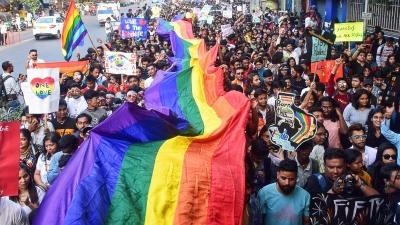
Kolkata, March 21 (IANS) Members of Kolkata’s queer community, along with legal experts, have raised serious concerns over the proposed Transgender Persons (Protection of Rights) Amendment Bill, 2026, alleging that it could restrict the right to self-identification for transgender persons.
The Bill, recently introduced in Parliament by Union Minister for Social Justice and Empowerment Virendra Kumar, has drawn criticism for allegedly narrowing the definition of transgender identity and proposing additional procedural requirements for legal recognition.
Activists and legal experts argue that the proposed legislation marks a departure from the landmark National Legal Services Authority v. Union of India (NALSA) verdict, in which the Supreme Court upheld the right to self-identify one’s gender without mandatory medical intervention.
They have also raised the question as to why it is always the “transgender” community who have to furnish evidence of their gender identity, unlike the “male” and “female”. IANS spoke to a cross-section of the Queer rights activists and legal experts, and all of them explained why the new bill is against the basic identity rights and their proclamations.
According to nationally acclaimed Queer writer and rights activist Pawan Dhall, the new Bill aims to narrow the definition of a transgender person and also calls for medical proof for legal recognition of that identity.
“The new Bill proposes to take away the free will of the members of the transgender community and put them under a screening in the name of producing medical proof for their legal recognition. Hence, what we feel is that the Bill should be sent to the Parliamentary Standing Committee for re-evaluation,” said Dhall, a former journalist and one of the founders of Kolkata’s annual LGBTQ Pride Walk, which is South-East Asia’s oldest pride walk.
He also explained that the new Bill is totally contrary to the NALSA verdict of 2014 and the Supreme Court’s clear observation that every single citizen of India, male, female, and others, has the option of deciding his or her own gender identity.
“This Bill is proposing to remove that option, and hence if any person wants to declare himself or herself as transgender person, he or she will have to go through an administrative process. Now, what they're saying is that there will be a medical board that will do the screening. And that is like a medicalisation, which is outdated, which is actually unethical, because if you have read the history, if you are aware of the history of medicine, you know, sexuality, gender, anything which is out of the norm has always been made a pathological issue," Dhall added.
Senior advocate of Calcutta High Court, Kaushik Gupta, is in total agreement with Dhall. According to him, in 2014, the Supreme Court talked about self-identification and also observed that insistence on sex reassignment surgery for establishing that identification process was not only immoral but also illegal.
“In the new Bill, since the definition of a ‘transgender’ person has been changed, largely excluding the trans-man community, that is, someone who is female by birth but identifies herself as a man, the new Bill will make the trans-man community vulnerable. Secondly, the screening process that the new Bill asks for to establish a ‘transgender’ identity is discriminatory in nature. When the state does not understand the subject very clearly, it should have had a nationwide consultation with transgender groups. They could have offered suggestions, but that was never done," Gupta told IANS.
Popular social media influencer and Queer Rights activist, Debika Barua, questioned why only the transgender community will always have to prove their identity, unlike “men” or “women”.
“Do men or women have to give proof that they are biologically men or women? Why do members of transgender community have to give medical proof of their gender? Is it not a violation of human rights? There is also no right to privacy. This is very unfortunate. The government is taking away the rights of transgender community and denying them social benefits. There is hardly any privilege for us. There is no grant for us. Most of us in rural places cannot afford sex reassignment surgery. Besides, not everyone is physically fit enough to go through the physical transformation during the surgery. How will they give proof?" Barua questioned.
Acclaimed transgender rights activist, Dr Ranjita Sinha, said that the proposed Bill had the risks of fundamentally weakening the constitutional principles undermining transgender rights and also threatened to exclude large sections of gender-diverse persons from recognition and protection.
"Gender identity cannot be reduced to a medical diagnosis or a bureaucratic certificate. It is a deeply personal and constitutional matter of dignity and self-determination. India's transgender communities have struggled for generations against stigma, violence, and systemic discrimination. Laws meant to address these injustices must expand recognition and protection -- not narrow them. While the Transgender Persons (Protection of Rights) Act, 2019 itself has been widely debated and criticised for falling short of the full promise of the NALSA judgment, any legislative reform must strengthen constitutional protections rather than dilute them." Sinha said.
--IANS
sch/skp